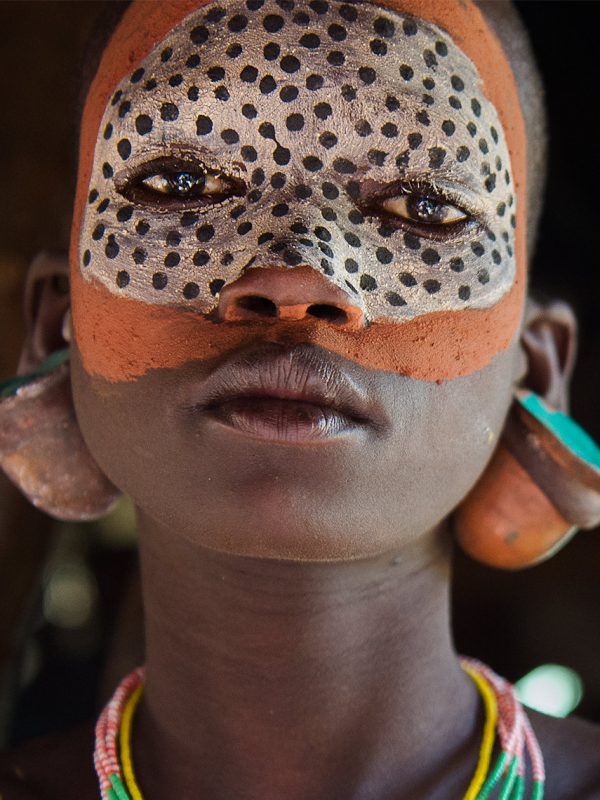
The social and cultural similarity of Suri with the Mursi and to a lesser extent with the Didinga and Larim in South Sudan is notable, and can be recognized in a similar kinship organization, in birth, marriage and funeral customs, in a patrilineal clan structure and in age grades and initiation rites for age-sets. All Suri groups together with the Mursi have a similar age-set structure, and initiations into a new set ideally occur every 20 years in a series from west to east, i.e., first the Baale and last the Mursi.
The Suri have lived in the Ethio-Sudan border area for many generations, successfully surviving through a combination of livestock herding (cattle, goats and sheep), some hunting and gathering, rain-fed cultivation of a variety of field crops like millet, corn, and sorghum, and the garden cultivation of legumes, spice plants, peas and beans. Migration has been restricted due to armed conflict, state pressure and some very serious droughts which have led to food shortages and even famines in the past few decades. Since the late 1980s the Suri have also gained cash income from the sale of alluvial gold to highland traders in nearby villages. During the last five to seven years, this trade has suffered from strong competition from highlanders and army–related people, who have tended to push the Suri out of business.
The Suri are a very interesting and tough people, who have had their share of problems with neighbouring peoples, like the Nyangatom (‘Bume’), the Anywa (Anuak), and the Dizi (an Omotic-speaking group of cultivators in the highlands around Maji, Tum and Jeba towns) who are closer to the government. Tensions also existed with the Toposa in South Sudan, allies of the Nyangatom, who frequently raided their cattle. There have also been violent clashes with the Tishana Me’en. Most problems in recent decades, however, have been with the authorities. The village highlanders, of mixed descent, tend to look down upon the Suri ‘nomads’. There is a dramatic history of conflicts and clashes of Suri with highlanders and national government officials, who have a deep distrust of the Suri and saw them always as uncivilized lowlanders ‘without religion’. This started under the Derg regime (1974-1991). Since about 1994 the Ethiopian state has stationed a military contingent among the Suri, allegedly for border patrol but, as it seems, primarily to intimidate the Suri. They have rarely helped the Suri in repelling the (cattle) raids of the Toposa coming from South Sudan into Ethiopia, although in 2007 a kind of truce was achieved. In recent years the consistent aim of the army has been to disarm the Suri, despite the fact that it has not guaranteed the security of the Suri vis-à-vis predations from neighbouring groups, including those from South Sudan.