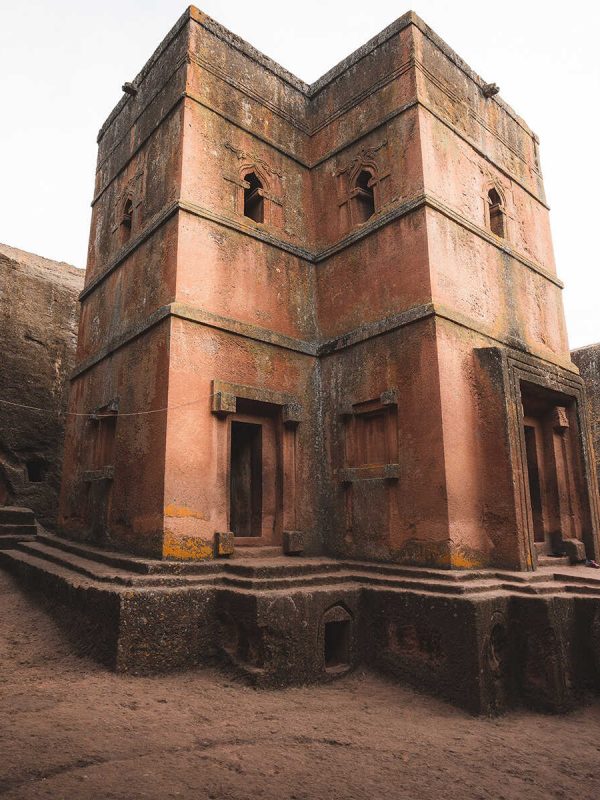
Lalibela, historical name Roha, religious and pilgrimage centre, north-central Ethiopia.
Historical Destination
Lalibela
Lalibela, historical name Roha, religious and pilgrimage centre, north-central Ethiopia. Roha, capital of the Zagwe dynasty for about 300 years, was renamed for its most distinguished monarch, Lalibela (late 12th–early 13th century), who, according to tradition, built the 11 monolithic churches for which the place is famous.
The churches, designated a UNESCO World Heritage site in 1978, were hewn out of solid rock (entirely below ground level) in a variety of styles. Generally, trenches were excavated in a rectangle, isolating a solid granite block. The block was then carved both externally and internally, the work proceeding from the top downward.
House of Giyorgis
House of Golgotha
House of Gabriel
House of Medhane Alem
The churches are arranged in two main groups, connected by subterranean passageways. One group, surrounded by a trench 36 feet (11 metres) deep, includes House of Emmanuel, House of Mercurios, Abba Libanos, and House of Gabriel, all carved from a single rock hill. House of Medhane Alem (“Saviour of the World”) is the largest church, 109 feet (33 metres) long, 77 feet (23 metres) wide, and 35 feet (10 metres) deep.
House of Giyorgis, cruciform in shape, is carved from a sloping rock terrace. House of Golgotha contains Lalibela’s tomb, and House of Mariam is noted for its frescoes. The interiors were hollowed out into naves and given vaulted ceilings.
Lalibela’s churches – designated the Eighth Wonder of the World – are considered among the most stunning monuments in Africa.
Built by Ethiopian king Lalibela, the story goes that the king was escorted by angels to Heaven where he was shown a city of churches. God then commanded him to return to Earth and recreate what he had seen by building a ‘Second Jerusalem’ on Ethiopian soil.
According to local archaeologists, a trench was first carved around a single massive pink block and the church crafted from that monolith and no bricks, blocks or joints of any kind are in evidence in the structure. Even getting to the church is an experience and you either go through a canyon-like excavation deep in the earth or in some cases through lightless tunnels barely wide enough to fit one person.
On Christmas Day, Around 100,000 white robed pilgrims make their way to this village of medieval churches that have been carved out of the ground to celebrate Christmas.