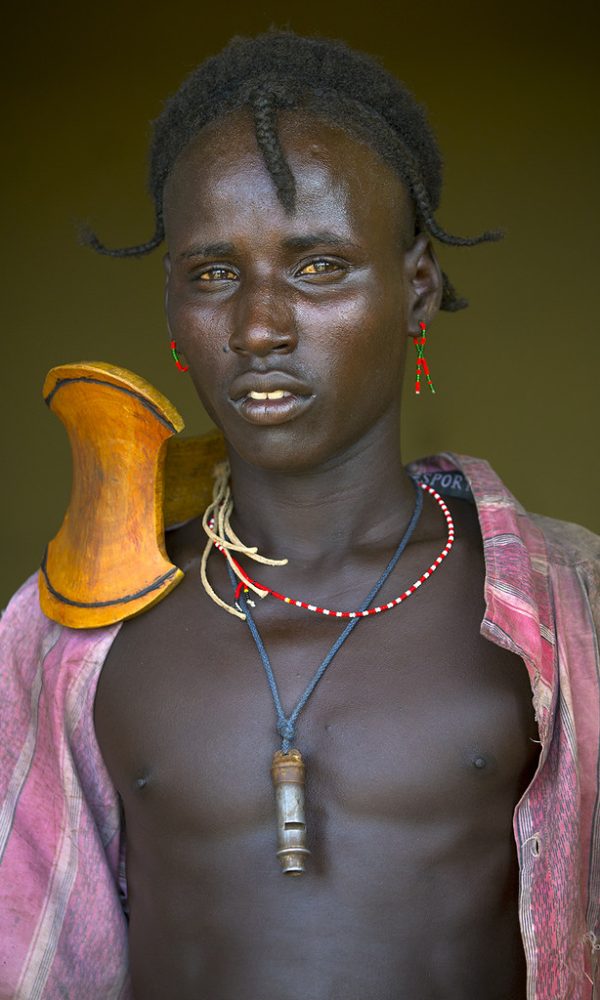
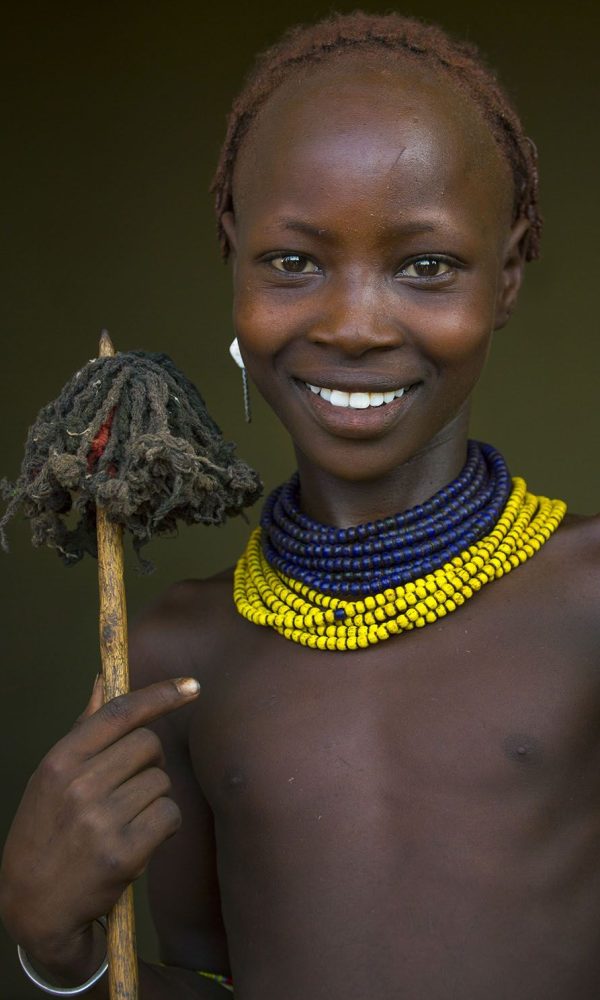
The Bodi live in the Omo Valley north of the Mursi. They number about 9500 people. They speak the Me’en language (Me’enen or tuk de Me’enuny) and call themselves Me’en.
The Dassanech/Geleb Tribe
The Daasanach (some authors write ‘Dassanetch’, ‘Dasanech’, ‘Daasanech’, or ‘Daasanetch’) speak an East Cushitic language and live in the semi-arid area around the Lower Omo Valley and the northern shore of Lake Turkana. They have also been referred to as ‘Geleb’ in Ethiopia and are known as ‘Merile’ and ‘Shangilla’ in Kenya. Daasanach in Ethiopia considered numbering just over 61,000. In addition, some thousands of Daasanach live in northwestern Kenya.
The Daasanach are made up of eight roughly co-residential territorial groups which conduct many rituals together. The INKABELO the largest of these groups, live at the centre of Daasanach land, on both sides of the Omo and its delta, along with three smaller groups, the ORO, the KUORO and the RIELE.The RANDA and the ELELE live in the northwestern part of Daasanach land. The INKORIA live on the northeastern shore of Lake Turkana, on the Kenyan side of the border. The NGARITCH are located to the north of the INKORIA.
According to oral tradition, many of these groups are the descendants of migrants who came to the Omo from various directions to escape such problems as famine and conflict and who thereby constructed ‘Daasanach’ society. For example, the INKABELO and the INKORIA (together known as SHIIR) lived at a place called Ger or Gerio, probably around the Kerio River on the southwestern side of Lake Turkana, along with the Nyube, or Pokot. When the Turkana (some elders told me the attackers were the Kuoro) attacked them in the early 19th century, the Nyube escaped southward to present Pokotland while the Inkabelo and Inkoria escaped northward, to present Daasanach land. The Randal and the Kuoro originated from the Rendille and the Samburu of northwestern Kenya. They moved to Daasanachland because of natural disasters in the last two decade of the 19th century.
Amongst the Daasanach, patrilineal clans (tuuro) or other kin groups do not function as co-resident groups. Although there is no fixed residential pattern for a village, it often consists of influential older men and their cognates, affines, age-mates, and friends. On the eastern side of the Omo there are generally between five and thirty houses per village while on the western side, where people are afraid of attack from neighbouring groups, there are generally more than fifty. The distance between villages on both sides of the river is more than several hundred metres.
All Daasanach men belong to a generation-set (haari). A man joins his set between the ages of fifteen and twenty through an initiation ceremony, after which he moves from the status of boy (nyigeny) to adolescent (kabana). After initiation men are able to marry and most are married before they are thirty. Girls marry between the ages of fifteen and twenty. When a couple’s first daughter reaches the age of approximately ten years they go through a ceremony known as dimi, after which they are recognized as social elders karsich.
In the area these people considered to be the poorest tribe due to a small number of cattle the tribes men own, however they also engage practicing agriculture and grow mainly Sorghum, maize, Tobacco, Millet so on, and these products recently become a valued source of cash-income.
The basic unit of production and consumption is a household (bil), consisting of a married man, his wife and their unmarried children. When a man marries a second wife, she builds a new house for herself and the husband moves between his wives’ houses every other day or every two days. He distributes livestock and arable land to his wives and each wife milks her own livestock, cultivates her land, stores crops, and cooks and eats meals separately with her children.